
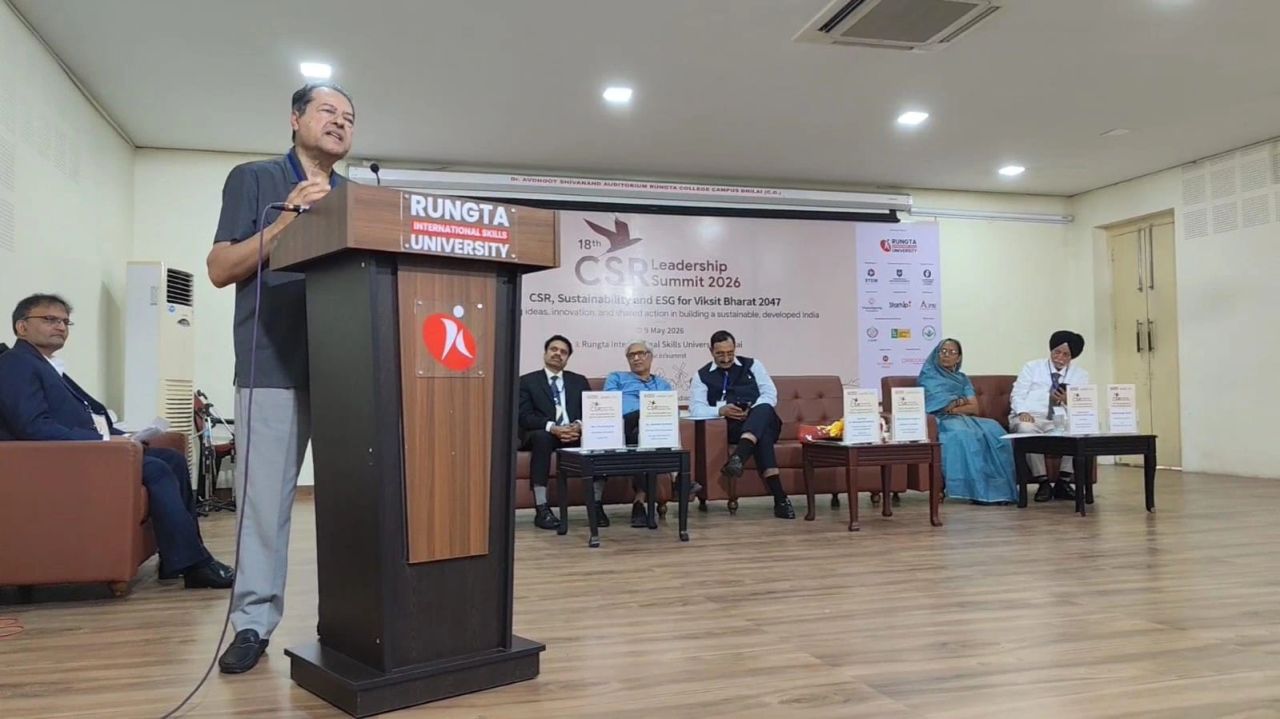
BHILAI. Addressing the 18th India CSR Leadership Summit 2026 as Chief Guest, Dr. Bhaskar Chatterjee, widely recognized as the Father of CSR and former Secretary of Corporate Affairs, Government of India, officially unveiled the National Seven-Point Agenda for CSR 2.0. Speaking at the Rungta International Skills University in Bhilai, Dr. Chatterjee emphasized that the future of Corporate Social Responsibility in India is rapidly shifting from basic philanthropy to a highly professionalized, high-impact discipline. He commended Rusen Kumar, Founder and Editor of the India CSR Network, for establishing a vital platform that unites academic practitioners and corporate leaders to drive the national dialogue on sustainability and ESG in alignment with the Viksit Bharat 2047 vision. He also expressed deep appreciation to Shri Santosh Rungta, Chancellor of the university, for hosting the prestigious event.
The newly introduced seven-point agenda places a heavy emphasis on robust research, standardized impact assessment, and professional education. To bridge the gap between academic study and field practice, Dr. Chatterjee announced the launch of the Chatterjee National CSR Fellowship, which will select one academic and one professional contributor annually. Furthermore, to ensure CSR initiatives deliver sustainable and measurable results, he has initiated six regional consultations to develop a standardized National CSR Social Impact Assessment Template, known as NCAT. This framework will unify sampling methodologies and quantitative techniques across the country. Dr. Chatterjee also stressed the urgent need for specialized degree programs in CSR and ESG to build a qualified cadre of professionals, much like CAs in finance and MBAs in marketing.
In addition to academic and professional training, the roadmap highlights technological integration and creative problem-solving as core pillars of CSR 2.0. The agenda calls for the adoption of AI-driven monitoring tools to secure complete transparency and guarantee that project benefits successfully reach the last mile. Dr. Chatterjee urged organizations to break away from repetitive, traditional projects in education and healthcare, advocating instead for out-of-the-box thinking and innovative project designs capable of tackling modern, complex societal challenges.
Finally, the agenda outlines a strategic shift toward institutional synergy and alignment with national governance. Dr. Chatterjee stated that CSR must evolve alongside ESG and sustainability, treating these three elements as a unified trinity essential for modern organizational growth. Rather than working in isolated silos, corporate social responsibility initiatives are encouraged to supplement and actively leverage ongoing government programs. By aligning corporate efforts with the vast resources and scale of the state, the corporate sector can effectively contribute to significantly larger national development goals.
