
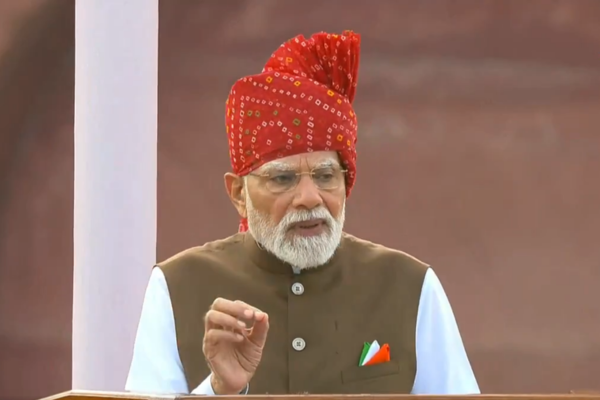
NEW DELHI. Prime Minister Narendra Modi, in his Independence Day address from the ramparts of the Red Fort, announced a series of major initiatives and ambitious targets covering artificial intelligence, education, sports, civil defence, semiconductor manufacturing, nuclear energy and women-led development.
Addressing the nation on India’s 80th Independence Day, PM Modi laid out an expansive roadmap aimed at accelerating the country’s transformation into a Viksit Bharat by 2047.
The Prime Minister placed a strong emphasis on empowering the country’s youth and strengthening rural communities. Among the key announcements were a plan to train 1 crore young Indians in artificial intelligence (AI) skills over the next year, the creation of a nationwide free online coaching network for competitive examinations, and an expanded target of 6 crore Lakhpati Didis.
He also announced a nationwide sports talent identification drive for children aged 5 to 15 years, with the initiative aimed at identifying and nurturing sporting talent as India prepares for its ambition to host the 2036 Olympic Games.
Focus on Self-Reliance and Strategic Sectors
Underlining the importance of self-reliance in critical sectors, PM Modi outlined ‘Shakti Ki Saptadhara’, a seven-pillar framework focused on manufacturing, technology and innovation, agriculture and food processing, infrastructure, defence, the green and blue economy, and India’s soft power.
The Prime Minister also highlighted the growing energy requirements of emerging technologies, including AI, data centres and semiconductor manufacturing. He set an ambitious target of achieving 100 GW of nuclear power capacity by 2047, while announcing plans to operationalise five new nuclear reactors within the current decade.
On the technology front, PM Modi emphasised the expansion of India’s semiconductor ecosystem. With three semiconductor plants already operational, he said that the country would work towards adding 5 to 8 more plants in the coming years, strengthening India’s position in global technology supply chains.
He also called for the creation of a modern and vibrant Civil Defence volunteer network capable of responding to emerging and non-conventional threats and protecting critical infrastructure, including data centres, refineries and banking systems.
