
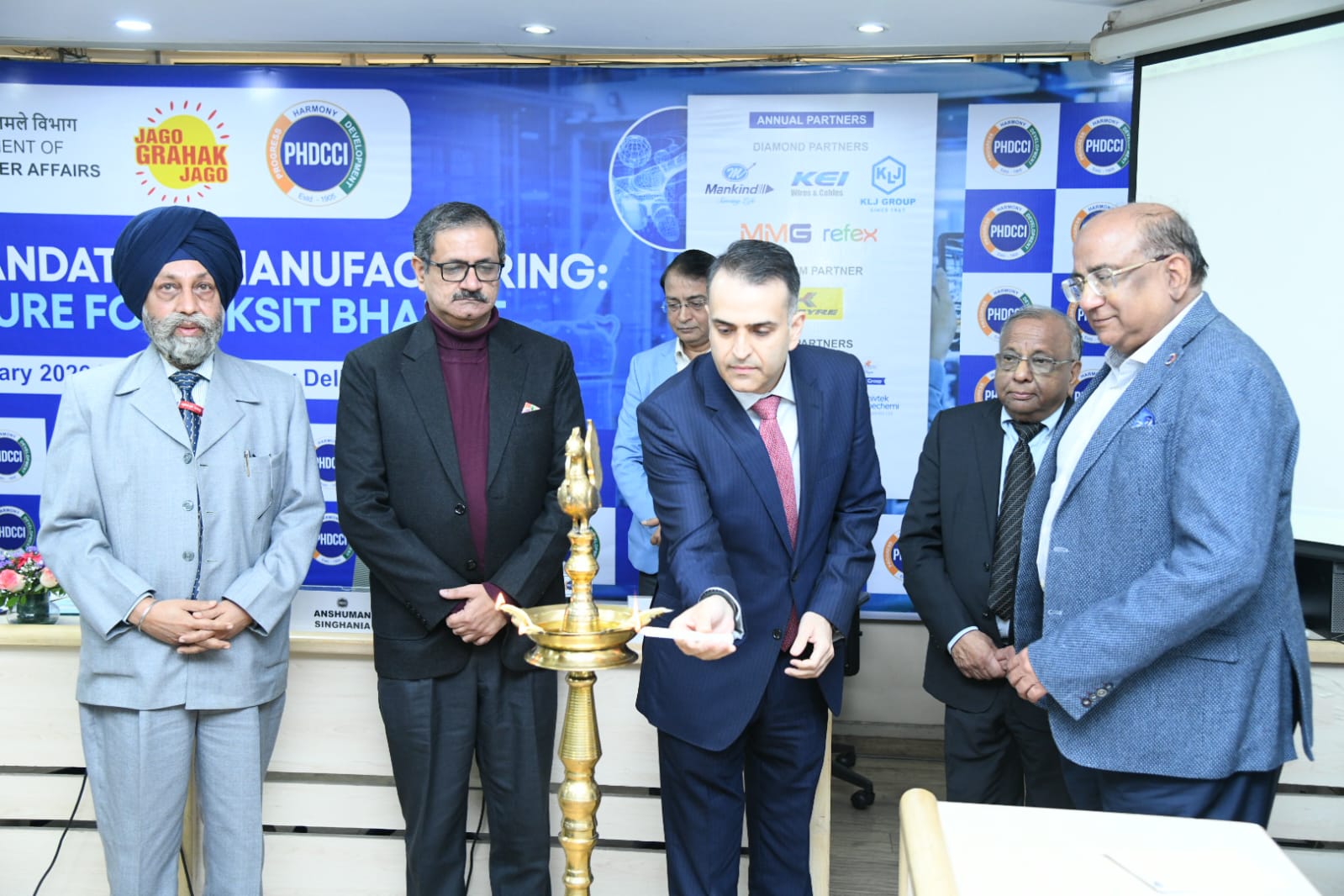
New Delhi | 20 January 2026 : Reaffirming that quality is the indispensable architecture of a Viksit Bharat, the PHDCCI convened a high-level national conference on “The Quality Mandate in Manufacturing: Architecture for Viksit Bharat” at PHD House, New Delhi. The conference served as a strategic platform for convergence between public policy, standard-setting institutions and industry leadership, at a time when India is positioning itself as a globally trusted manufacturing hub.
The conference was graced by Shri Bharat Khera, Additional Secretary, Department of Consumer Affairs, Ministry of Consumer Affairs, Food & Public Distribution, Government of India, as the Chief Guest, and Shri H.J.S. Pasricha, Scientist-G & Deputy Director General (Certification), Bureau of Indian Standards (BIS) as Guest of Honour. Senior industry leaders including Shri Sunil Mangla (Chair), Shri Anshuman Singhania (Co-Chair) and Shri Prem Singhania (Co-Chair), PHDCCI Manufacturing Committee, along with policymakers, regulators, MSMEs, exporters, testing bodies and technical experts participated in the deliberations.
In his address, Shri Bharat Khera emphasised that the aspiration of Viksit Bharat 2047 cannot be realised through scale of production alone, but must be anchored in credibility, consistency and global trust in Indian products. He emphasized that quality is not a regulatory burden, but a strategic enabler facilitating market access, enhancing brand differentiation and embedding India firmly within global value chains. Highlighting the strategic importance of standardisation, Shri Khera noted that nearly 95 per cent of Indian Standards are harmonised with ISO and IEC benchmarks, with calibrated India-specific adaptations reflecting climatic, safety and contextual requirements. He also pointed out India’s growing leadership in sectors such as AYUSH, where the country is increasingly shaping international standards. Addressing industry concerns on regulatory implementation, Shri Khera stressed that Quality Control Orders (QCOs) must be phased, consultative and predictable, supported by adequate testing infrastructure and stakeholder preparedness. He reaffirmed the Government’s commitment to protecting quality-compliant enterprises particularly MSMEs by ensuring a level playing field for both domestic and foreign manufacturers. Recognising MSMEs as the backbone of India’s manufacturing ecosystem, Shri Khera highlighted that over 80 per cent of BIS licensees out of more than 55,000 certifications belong to the MSME sector, reflecting voluntary industry alignment with quality norms. He detailed BIS-led facilitation measures including simplified certification procedures, cluster-based testing options, extensive hand-holding through branch offices, and significant fee concessions 80% for micro, 50% for small and 20% for medium enterprises, with proposals underway to extend these concessions beyond 2026.
Shri H.J.S. Pasricha elaborated on BIS’s role as India’s National Standards Body, with over 23,000 published standards across 17 sectors, developed through a robust ecosystem. He emphasized that standards are meaningful only when industry leads their conception, revision and adoption.
Shri Pasricha urged industry associations to institutionalise standardisation cells, enabling proactive identification of emerging standard needs and faster harmonisation with global benchmarks. He highlighted key reforms including free access to Indian Standards, digitised certification platforms, recognition of nearly 700 testing laboratories, flexibility in testing infrastructure (including shared and cluster labs), and simplified surveillance-based quality assurance models.
Shri Sunil Mangla, Chair, PHDCCI Manufacturing Committee, stated that India stands at a defining juncture where quality must evolve from a compliance obligation to an organisational culture. He stressed that government, regulators, BIS, testing bodies, industry and chambers are collective custodians of the national quality ecosystem, and called for expanded testing infrastructure, faster certification timelines and rationalised testing costs.
Shri Anshuman Singhania, Co-Chair, PHDCCI Manufacturing Committee highlighted that global manufacturing competitiveness today is driven by reliability, safety, sustainability and traceability, necessitating adoption of Industry 4.0 tools, digital quality management systems, AI and IoT. He emphasised that MSMEs must be enabled through capacity building and infrastructure access—to participate meaningfully in this transition.
Shri Prem Singhania Co-Chair, PHDCCI Manufacturing Committee observed that the conference decisively aligned policy intent with industry readiness, and set the foundation for sector-specific, outcome-oriented engagements going forward.
Dr. Nasir Jamal, Director, PHDCCI, while moderating the session, underscored that quality-led manufacturing is critical to India’s global competitiveness, export growth and value-chain upgradation. He noted that a sustained focus on quality enables India’s transition from low-cost production to high-value, innovation-driven manufacturing, strengthening Brand India. Dr. Jamal also highlighted PHDCCI’s continued engagement with multiple ministries to promote quality frameworks, including initiatives on Good Manufacturing Practices (GMP), reaffirming the Chamber’s commitment to supporting industry particularly MSMEs and startups in aligning with global standards.
The conference concluded with a shared consensus that quality is a national strategic asset, integral to exports, consumer trust, sustainability and India’s global reputation. PHDCCI reaffirmed its commitment to act as a knowledge bridge, consensus builder and industry enabler, working closely with the Government of India, BIS and industry stakeholders to translate the Viksit Bharat 2047 vision into a resilient, quality-driven manufacturing reality.
